
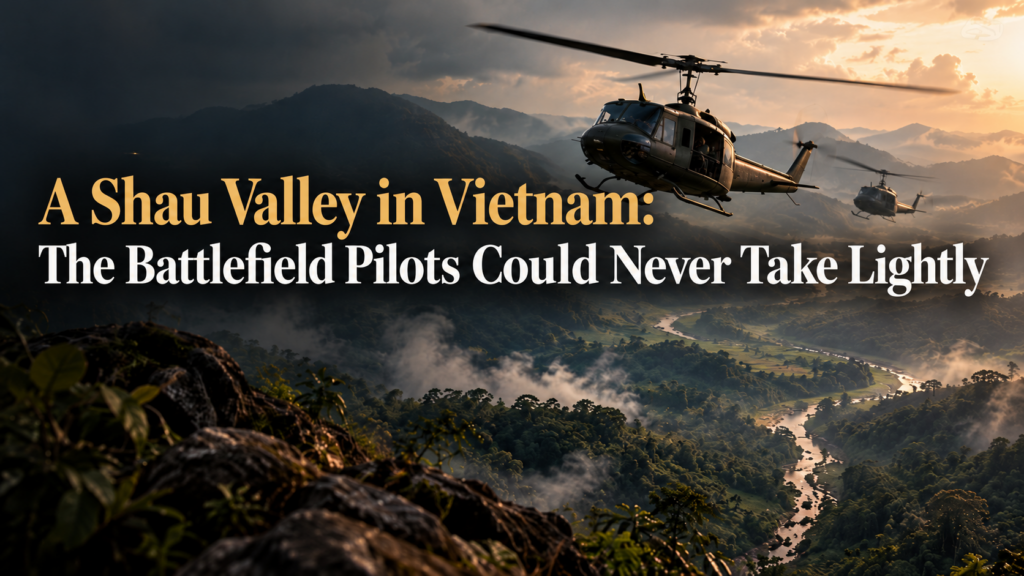
Some battlefields announced themselves with explosions. Others looked dangerous before a shot was ever fired.
The A Shau Valley belonged to the second kind.
For helicopter crews entering it in 1968, the danger came from almost every direction. Mountains rose around the valley. Jungle covered the ridgelines. The weather could close in quickly. North Vietnamese forces had built supply routes and defensive positions through the region, and aircraft entering the area faced serious antiaircraft fire.
For David Hardman, the valley was not simply another name on a military map. It became the place where his helicopter was shot down for the first time.
That moment says a great deal about why American pilots learned to respect this battlefield.
A Valley That Was More Than a Piece of Ground
The A Shau Valley Vietnam campaign area sat in western South Vietnam, near the border with Laos.
Its location mattered because the valley connected with the wider logistical network used by North Vietnamese forces moving men, weapons, ammunition, food, and other supplies southward.
The U.S. Army’s official history describes the valley as part of an important enemy logistical system connected to routes coming from Laos. Large quantities of war material moving down the Ho Chi Minh Trail could pass through nearby Base Area 607 before entering the valley through mountain passes.
That made the valley valuable for reasons that had little to do with towns or civilian population centers.
It offered the North Vietnamese Army:
- Natural concealment from thick jungle
- Access to routes leading from Laos
- Areas for storing weapons and supplies
- Mountain terrain that could support defensive positions
- A region difficult for conventional ground forces to enter quickly
- Opportunities to position antiaircraft weapons against helicopters and fixed-wing aircraft
For American commanders, leaving such a supply area untouched carried its own risks.
Entering it carried even greater ones.
Also read : Were There Helicopters in the Vietnam War? How Army Aviation Changed Combat
Why the Terrain Changed the Rules for Pilots
Looking at an A Shau Valley Vietnam map can explain part of the difficulty, but a map cannot fully communicate what the terrain meant from a cockpit.
A pilot did not simply see a valley floor surrounded by hills.
He had to think about what those hills could hide.
A ridgeline might conceal automatic weapons. Jungle canopy could make enemy positions nearly invisible until they opened fire. A small clearing might be the only possible emergency landing site for miles. Low clouds could reduce visibility around high terrain. Helicopters carrying troops or supplies had to expose themselves during approaches and departures.
Then there was the basic problem of altitude. North Vietnamese forces could occupy higher ground while American helicopters had to descend toward landing zones below them.
That created a dangerous combination. A helicopter’s greatest advantage was mobility. The terrain could turn that mobility into vulnerability.
Also read : Vietnam War
Operation Delaware Took the War Into the Valley
After the relief of Khe Sanh through Operation Pegasus, American planners turned their attention toward the valley.
Operation Delaware/Lam Son 216 began on April 19, 1968. Elements of the 1st Cavalry Division, the 101st Airborne Division, and South Vietnamese forces participated in the wider effort.
The plan called for a major reconnaissance-in-force operation intended to enter an area that had served as an important North Vietnamese logistical sanctuary.
It was ambitious for several reasons.
American commanders expected:
- Difficult mountain terrain
- Marginal flying weather
- Strong enemy reinforcement possibilities from Laos
- Extensive antiaircraft defenses
- Serious logistical challenges
- Helicopter operations beyond the normal protection of supporting artillery during parts of the advance
An official Army history described the operation as potentially more dangerous than previous offensive operations because difficult terrain, weather, reinforcement routes from Laos, and enemy air defenses all came together in one place.
For pilots, that meant entering a battlefield where no single problem existed by itself.
Everything could go wrong at once.
David Hardman Heard the Warning Before He Ever Entered
In First Tour, David Hardman places the reader inside the April 17 briefing before Operation Delaware.
Captain Talley explains that North Vietnamese forces had used the valley as a major supply route and storage area. B Troop’s responsibility would include reconnaissance, intelligence gathering, checking possible landing zones, locating enemy activity, and helping neutralize dangerous positions before larger troop movements began.
The briefing also makes an important comparison.
Talley reminds the pilots of Dien Bien Phu, where the French had suffered a disastrous defeat after Viet Minh forces controlled the surrounding high ground. His warning was clear: the First Cavalry Division could not allow the valley’s terrain to produce a similar result.
That comparison was more than dramatic language.
High ground matters in war.
In a helicopter war, it matters even more.
Also read : A Shau Valley
Before the Shooting Came the Routine
One reason Hardman’s account works so well is that he does not begin the mission with immediate chaos.
He begins with preparation.
After the briefing, crews prepare for a pre-dawn departure. Hardman eats a C-ration breakfast, collects his helmet, armor, and maps, and reaches the flight line while his crew checks the aircraft.
His copilot examines the helicopter’s controls and rotor system.
The gunners prepare their M60s.
Radio checks follow.
Then the aircraft lifts into darkness.
This routine is important because combat aviation depended on hundreds of small actions being done correctly before the aircraft ever reached hostile territory.
A pilot had to think about:
- Fuel
- Weather
- Navigation
- Radio frequencies
- Weapons
- Crew coordination
- Aircraft condition
- Emergency landing options
- Friendly positions
- Enemy positions
- Terrain
A mistake in any one of those areas could become far more serious once the shooting started.
Hardman’s flight entered the valley before sunrise, moving low beneath ridgelines whenever possible. The scout aircraft worked closer to the terrain while his gunship remained slightly above and behind, positioned to react if the scout attracted fire.
That was the basic logic of the hunter-killer team.
The scout searched.
The gunship watched over him.
And both were exposed.
Also read : Battle of Khe Sanh
Then the Valley Answered Back
For roughly twenty minutes, Hardman’s crew moved through the mission. Then they heard automatic weapons. The shooting came quickly.
His gunners returned fire while Hardman tried to climb along the ridgeline. Bullets struck the helicopter.
Then the engine began losing power. His rotor RPM started falling. Hardman transmitted the words no pilot wanted to say: His aircraft was going down. There was no time for a long plan.
He lowered the collective, pushed the nose down, and traded altitude for airspeed to recover rotor RPM. Then he needed somewhere to land. Immediately.
A Small Clearing Became the Only Choice
Hardman spotted an opening in the trees roughly two hundred meters downslope. It was not a comfortable landing area. It was simply better than having no landing area at all.
The helicopter descended rapidly. Hardman flared above the trees, pulled collective, and hit the ground hard enough that the aircraft nearly rolled. But it stayed upright. The crew got out quickly. Weapons came with them.
A defensive perimeter went up around the damaged helicopter while rescue forces moved toward their position.
That sequence captures one of the defining realities of the Vietnam A Shau Valley fighting. A helicopter could move troops across terrain that would take ground forces far longer to cross.
But when that helicopter went down, the terrain immediately reclaimed control. Jungle became a wall. A clearing became a lifeline. Nearby friendly aircraft became the difference between rescue and isolation.
Being Shot Down Did Not End Hardman’s Day
The remarkable part comes after the rescue.
Hardman and his crew are extracted and returned to Camp Evans.
For most people, being shot down would be more than enough excitement for one day.
Not in this case.
When Hardman reaches operations, Major Hallthorn asks how his nerves are holding up.
Hardman answers that apart from being shot down for the first time, he is all right.
Then Hallthorn tells him that he and his copilot will need to take the standby aircraft and return to the valley.
That detail says as much about combat aviation as the crash itself.
There was rarely much time to process what had happened.
Another aircraft existed.
The mission was still underway.
So the pilot went back.
Why Helicopters Were Essential Despite the Risk
The danger was obvious, but helicopters remained indispensable to Operation Delaware.
The terrain made ordinary movement painfully difficult. Roads were limited, vegetation was dense, and enemy forces had spent considerable time using the region as a sanctuary.
Helicopters allowed commanders to bypass some of those obstacles.
They could:
- Insert infantry into landing zones
- Move reconnaissance teams
- Deliver supplies
- Evacuate wounded personnel
- Shift units rapidly between positions
- Carry artillery and equipment
- Rescue downed aircrews
- Support troops with gunships
- Reach areas unavailable to normal vehicles
Heavy-lift helicopters even carried engineering equipment into the area. Army aviation history records that engineers improved the airfield at A Luoi until it could eventually accept larger cargo aircraft, helping turn a difficult valley operation into a more sustainable logistical effort.
The helicopter did not remove the terrain problem.
It changed the way commanders could deal with it.
Also read : How Did the Vietnam Draft Work? Ages, Lottery Numbers, Deferments, and Key Years
The Enemy Knew What Helicopters Made Possible
North Vietnamese forces understood the same thing.
If American helicopters could move freely, they could put troops into areas that would otherwise remain difficult to reach.
That made helicopters valuable targets.
Army histories of the operation repeatedly mention heavy antiaircraft fire. During the opening phase, enemy defenses immediately challenged the helicopter assaults. Poor weather complicated the situation further, delaying the establishment of some positions and making resupply harder.
This explains why the A Shau Valley battle cannot be understood simply as infantry fighting on the ground.
The airspace itself was contested.
Pilots were not merely taxi drivers delivering soldiers to battle.
They were operating inside the battle.
Weather Could Be Almost as Dangerous as Gunfire
Enemy fire was visible once it started.
Weather could be harder to judge.
Mountain regions can create rapidly changing conditions. Low cloud cover can hide ridges, limit visibility, complicate navigation, and make landing zones difficult to locate.
For helicopter crews, poor weather added another layer of decision-making.
Should they continue?
Could they maintain visual contact with the terrain?
Would the clouds allow support aircraft to reach them?
Could medical evacuation aircraft get in?
Could supplies get out?
During Operation Delaware, official histories note that poor weather disrupted both helicopter assaults and fixed-wing resupply missions.
Pilots could prepare for enemy fire.
They could not command the clouds to move.
What Operation Delaware Found
American and South Vietnamese forces eventually pushed deeper into the valley and uncovered large enemy supply caches and logistical facilities.
The findings included weapons, food, equipment, documents, and infrastructure connected with North Vietnamese operations.
According to the U.S. Army’s official history, the operation demonstrated that the area was no longer completely beyond allied reach. The Army credits the campaign with capturing or destroying significant quantities of enemy supplies and gathering valuable information about the logistical network operating through the region.
But success came with losses.
Aircraft were damaged.
Helicopters were destroyed.
American and South Vietnamese soldiers were killed.
And the North Vietnamese did not permanently abandon the region.
That last point matters.
A successful operation could enter the valley.
It could disrupt supply systems.
It could destroy equipment.
But geography remained geography.
Once allied forces left, North Vietnamese forces had reasons to return.
Why Pilots Never Treated the Valley as Routine
There were dangerous missions throughout Vietnam.
The valley combined too many hazards for complacency:
- Mountainous terrain restricted escape options.
- Heavy jungle concealed enemy positions.
- Strong antiaircraft defenses threatened low-flying aircraft.
- Weather could close routes without warning.
- Supply lines depended heavily on aviation.
- Emergency landing areas were scarce.
- North Vietnamese forces could reinforce from nearby Laos.
- Crews often operated far from the comfort of established bases.
Any one of those dangers would have demanded attention.
Together, they created a battlefield that punished mistakes quickly.
That is why First Tour makes this chapter particularly memorable. Hardman enters the operation as an experienced aircraft commander, not the uncertain new pilot who had arrived in Vietnam months earlier. Yet experience does not make him untouchable.
His helicopter still gets hit.
His engine still fails.
He still needs a clearing.
He still needs another crew to come get him.
Skill mattered.
So did teamwork.
And sometimes survival still depended on finding one small patch of open ground before the rotor stopped turning.
FAQs
Where was the A Shau Valley located during the Vietnam War?
The valley was in western South Vietnam near the Laotian border. Its position made it important because routes from Laos connected it with the wider North Vietnamese logistical system associated with the Ho Chi Minh Trail.
Why was the A Shau Valley strategically important?
It provided access to routes, storage areas, and supply networks used by North Vietnamese forces. Its remote location, jungle cover, and proximity to Laos also made it difficult for American and South Vietnamese forces to control permanently.
What was Operation Delaware?
Operation Delaware/Lam Son 216 was an allied operation launched in April 1968 involving the 1st Cavalry Division, other American units, and South Vietnamese forces. Its purpose included entering the valley, disrupting enemy logistical networks, conducting reconnaissance, and locating or destroying military supplies and positions.
Why was flying in the A Shau Valley so dangerous?
Pilots faced steep terrain, jungle-covered ridges, poor weather, limited landing areas, and significant enemy antiaircraft fire. These conditions were particularly dangerous for helicopters because many missions required them to operate low enough for enemy ground weapons to engage them effectively.
Was David Hardman shot down in the A Shau Valley?
According to First Tour, yes. During an early reconnaissance mission connected with Operation Delaware, Hardman’s helicopter took enemy fire and lost engine power. He autorotated toward a small clearing and made a hard emergency landing before he and his crew were extracted.